Authored by Fundacion Huesped: Paloma Loreti Gambaccini, Public Advocacy Analyst; Julia Kors, Senior Public Advocacy Analyst, and Camila Serrao, Researcher
As part of the SPHERE consortium, Fundacion Huesped participated in two key international events in the second half of 2025: the Science for Health Systems Conference in St. Louis, USA and the International Conference on Family Planning (ICFP) in Bogota, Colombia.
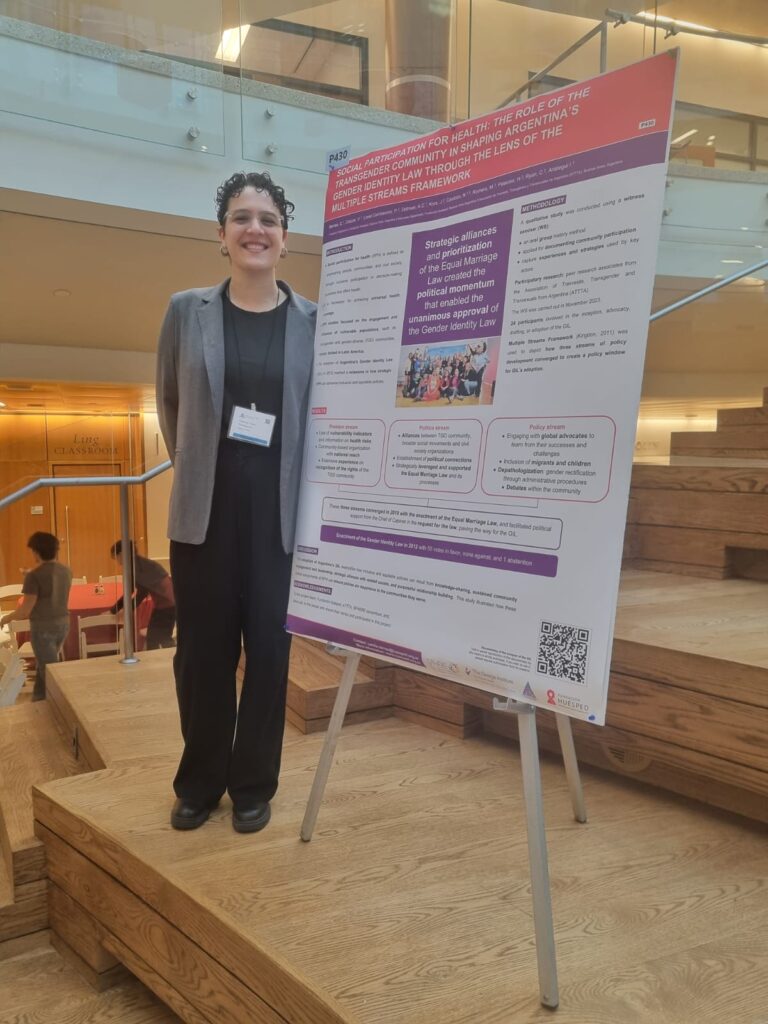
The Science for Health Systems Conference brought together researchers, policymakers, and implementation actors from diverse disciplines and regions to share cutting-edge work on measuring and improving health system performance. At this conference, Paloma Loreti Gambaccini from Fundación Huésped presented a poster, jointly developed with the Association of Travestis, Transsexuals and Transgender People of Argentina (ATTTA), on the role of the trans community in achieving Argentina’s Gender Identity Law. The analysis was framed using the Multiple Streams Framework, which allows for an understanding that the law’s adoption was not a linear process. Rather, policy change emerged from the convergence of social problems, available policy solutions, and political opportunity structures. This perspective helps make visible how community leadership and favorable political conditions came together to advance transformative health-related legislation.
We were particularly pleased to be selected as one of the few initiatives representing Latin America, and as the only contribution addressing issues related to LBGT+ communities within the conference. Attendees showed strong interest in the witness seminar methodology, including participant selection and in the political context and changes since the adoption of the law. In conversations with multiple people, this methodology and approach on the work with communities was frequently highlighted for its strong potential to document groundbreaking experiences and to foster spaces for reflection and collective discussion on policies affecting their rights.
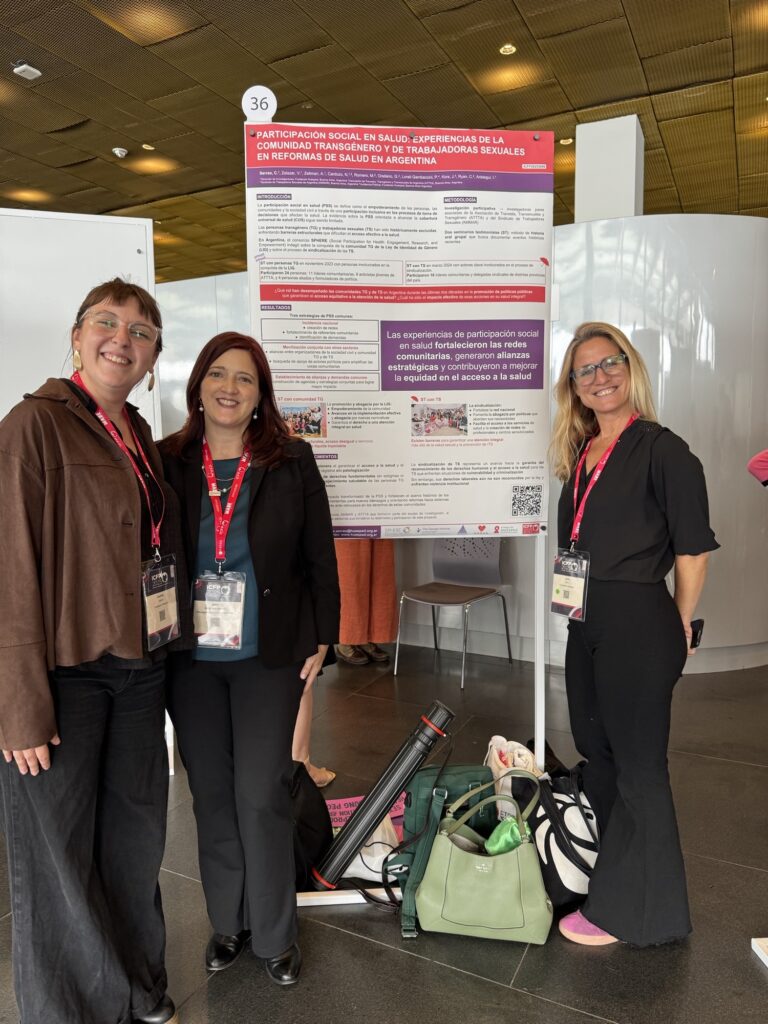
In addition, Fundacion Huesped, together with ATTTA and the Sex Workers Union of Argentina (AMMAR), participated in the ICFP 2025, a conference characterized by strong engagement from activists, public officials, and academics, united by the conviction that social participation is a fundamental condition for ensuring equitable access to health.
On this occasion, Julia Kors and Camila Serrao from Fundación Huésped, presented the work “Social participation for health: Experiences of transgender communities and sex workers in health reforms in Argentina” that examined two landmark experiences of community organizing: the achievement of the Gender Identity Law driven by the trans community, and the process of sex workers’ unionization. Both cases illustrate how community leadership and collective advocacy can shape public policies, expand rights, and strengthen access to health services from an equity and human rights perspective.
The presentation attracted considerable interest due to the witness seminar methodology, particularly because of its potential to recover the voices of the protagonists themselves in processes of social participation in health. In particular, the case of the Gender Identity Law was recognized by many conference participants as a significant community achievement, as it made it possible to reconstruct the collective process through diverse and complementary voices.
Likewise, the existence of the sex workers’ union and its integration into the Argentine Workers’ Confederation generated marked interest, highlighting their struggle for the recognition of labor rights and their status as rights-bearing subjects. In the exchanges prompted by these Argentine experiences, it became evident how the active participation of the communities themselves constitutes a fundamental pathway for the achievement and expansion of rights.
During both conferences, special emphasis was placed on the importance of including communities in research processes, which added further value to the methodology employed. In this sense, bringing Latin American experiences to these types of academic spaces contributes to the construction of knowledge from the Global South.
These international spaces allowed us to build networks with actors advocating for universal health coverage worldwide and to reflect on diverse health system models. We firmly believe that these opportunities are essential for mutual learning, capacity building, and the strengthening of global collaborations committed to more inclusive and equitable health systems. Moreover, we consider it fundamental to ensure the representation of experiences of social participation in health, particularly those grounded in the co-construction of initiatives and approaches by and with communities that continue to face significant barriers to accessing health care. In this case, the experiences of the trans communities and sex workers offer powerful examples of transformative policymaking aimed at improving their lives.